Maxim #23:
A Great Example Is Your Best Teacher
To increase your winning percentage, study winning ads like the outstanding example below.
Dear Marketing Maven,
Quick review…
Advertising can be such a mighty force in creating wealth because it empowers you to make an effective sales presentation to thousands or even millions of your best prospects at once.
But to do that, the first thing we must remember is the maxim: “You can get anything you want in life if you help enough other people get what they want.” In other words, persuasion begins with a crystal-clear focus on what your prospects want.
And that’s why the Unique Selling Proposition (USP) is such a powerful tool. Whether you’re an entrepreneur, CEO, marketing director or copywriter, the USP grabs you by the shoulders and demands that you stop thinking about what YOU want and focus instead on the uppermost question on the minds of your prospects, namely…
Why should I buy from you instead of your many competitors?
When everyone involved with marketing — from the CEO to the copywriter — focuses on providing clear, accurate, provable, and motivating answers to this question from the prospect’s point of view, you’ll enjoy a much higher probability of success.
Let me illustrate with one of my favorite examples.
Robert D. Kephart was a publisher, direct-marketer, and skilled entrepreneur. In the 1970s, he learned about recorded foreign-language courses that had been created by the U.S. Foreign Service Institute. These government-published courses were in the public domain.
So Bob remastered the lessons onto audio cassettes. He obtained the corresponding manuals from the Government Printing Office and packaged everything into albums to be offered for sale by Audio-Forum, one of his company’s divisions.
The ad was written by one of the all-time great copywriters, Don Hauptman, who had learned about the USP strategy by reading Rosser Reeves’ book, Reality in Advertising.
Let’s look at the ad and then let Don explain how it came to be…
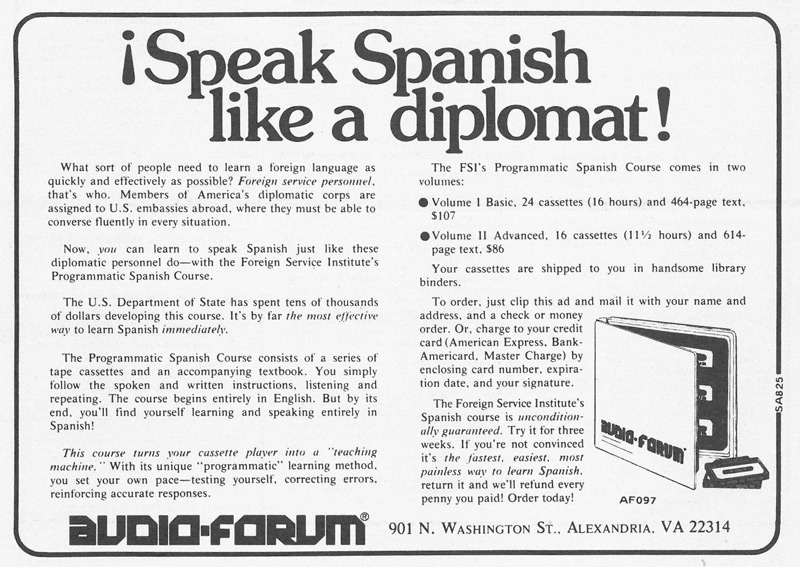
This ad was so successful that it ran for at least 17 years and triggered more than $20,000,000 in sales! Yes, twenty million!
Why did it work so well…and what does it teach?
Don Hauptman explains…
“I got out of the Navy in 1974 and couldn’t get a job offer from the ‘Mad Men’ Madison Avenue agencies. A friend put me in touch with publisher Robert D. Kephart. Bob told me that he was planning to market language courses developed by the Foreign Service Institute, part of the U.S. Department of State.
“I was still a fledgling copywriter. Bob became a mentor as well as a client and I learned a lot from him. I remember asking what he thought the Unique Selling Proposition here was. He replied: ‘Well, I suppose it’s that this is how diplomatic people all over the world learn to speak the local language.’
“So, the headline almost wrote itself: ‘Speak Spanish Like a Diplomat!’ The designer came up with the idea of preceding it with the Spanish inverted exclamation point. Later, we adapted the copy for the French and German and Hebrew courses. We had the sense that buyers bought them for business purposes, not tourism.
“It was all so serendipitous that I can’t claim that the headline was the result of creative genius or mystical inspiration. Still, sometime later, after another meeting, one of Bob’s executives, Steve Ganslen, was driving me to the airport. Out of the blue, he said: ‘Everyone knows and praises the headline. But hardly anyone recognizes the power of the opening paragraph.’ So, I can claim some credit for that. It reads: ‘What sort of people need to learn a foreign language as quickly and effectively as possible? Foreign service personnel, that’s who! Members of America’s diplomatic corps are assigned to U.S. embassies abroad, where they must be able to converse fluently in every situation.’
“The ad ran in dozens of magazines and newspapers: The Wall Street Journal, The New York Times, The Economist, Travel & Leisure, The New Republic, National Review, Harper’s, Smithsonian, and many inflight and city magazines.
“Bob later sold Audio-Forum to a Connecticut publisher named Jeffrey Norton. Jeff told me that the sales to that point were around $20 million. I was paid a grand total of $75! Royalties for copywriters were not common then. But the ad achieved the status of an industry classic. My having been the copywriter probably got me clients and allowed me to raise my fees.
“The headline even entered the language. A newspaper cartoon depicted a couple at a party, where a woman is excusing her husband’s behavior: ‘Fred has been impossible since he learned to speak French like a diplomat.’
“The ad is reproduced in two college advertising textbooks.
“What made the ad so successful? One word comes to mind: curiosity. Suppose the headline had been: ‘Speak Spanish Like a Native.’ Ho-hum. The word diplomat was so unusual that readers were likely gobsmacked. It got their attention and motivated them to read on, and in some cases, to order.
“The companies noted above no longer exist, but I often think that the ad could still work today if an enterprising marketer were to try it again.”
* * *
Don Hauptman’s five principles for creating powerful ads
- Start with the prospect instead of the product. Avoid superlatives and brag-and-boast language. Wherever possible, incorporate anecdotes, testimonials, success stories, and other believable elements of human interest.
- Do the research. Interview customers, ask questions, listen carefully. My favorite question is: What are the prospect’s greatest problems, needs, and concerns right now? At least half the time spent on an assignment should be pure research — before attacking the blank page or computer screen.
- Use specifics to add power and credibility. Use precise, documented figures and facts in advertising. Cite data or opinions from outside, impartial sources. A lot of copy is anemic and ineffective because it’s superficial, vague, and unspecific. Concrete statements and detail supply the ring of truth. But to find this kind of material, you’ve often got to dig for it.
- Don’t try to change behavior. It’s time-consuming, expensive, and often futile. It’s usually wise to capitalize on existing motivations. In other words, preach to the converted. Unless you have an unlimited budget, avoid products and services that require the buyer to be educated or radically transformed.
- Be a “creative plagiarist.” You can learn by studying the work of others. But don’t imitate. When you see an idea you admire, try to identify the principles behind it, then apply those principles in a fresh, original way to your own work.
* * *
If you aim to be at the top of your marketing game, Don’s excellent advice is worth reviewing regularly — especially his focus on identifying the USP before writing a word.
Note: Don is now retired as a copywriter, but he regularly redeploys his knowledge and experience as a pro bono consultant on marketing and fundraising to favored causes. He also writes on language, a longtime passion, especially on its lighter side: puns and wordplay, a genre that some call “recreational linguistics.”
Sincere wishes for a good life and (always!) higher response,
Gary Bencivenga
P.S. If you know any copywriters or marketers who would enjoy these Marketing Maxims, just send them an email with this link: https://marketingmaxims.com/
P.P.S. Your email address will never be shared. And if you ever wish to unsubscribe, just let me know and I will vanish from your life like a shadow in the night.
To visit Gary’s Marketing Maxims Archive, click here.
To Subscribe to these Marketing Maxims, a hype-free zone, click below.
Get your FREE Subscription to Gary Bencivenga's Marketing Maxims